The accelerating destruction of the rainforests that form a precious cooling band around the Earth's equator, is now being recognised as one of the main causes of climate change. Carbon emissions from deforestation far outstrip damage caused by planes and automobiles and factories.
The rampant slashing and burning of tropical forests is second only to the energy sector as a source of greenhouses gases according to report published today by the Oxford-based Global Canopy Programme, an alliance of leading rainforest scientists
Sunday, December 12, 2010

Friday, November 5, 2010
Rivers run dry as drought hits Amazon

MUTUM, Brazil — A motorboat barreling through the night up a shallow Amazon stream could only beat the odds for so long.
Just after 9 p.m., the aluminum canoe slammed to a halt with the sound of a thunderclap. Passengers and cargo lurched into the air. Shouts of surprise, profanity and a man-sized splash echoed in the dark.
A swift lesson on Newtonian physics and the risks of night boating had been delivered by a large, semi-submerged tree.
The mishap demonstrated what everyone in this remote corner of the Brazilian jungle had been saying for days.
The world’s largest rain forest was dangerously dry, and may well be drying out.
But not this year, and the drought’s significance extends far beyond impeded boats.
While the region has seen dry spells before, locals and experts say droughts have grown more frequent and severe. Scientists say there’s mounting evidence the Amazon's shifting weather may be caused by global climate change.

Thursday, October 21, 2010

Tuesday, September 14, 2010
Scientists investigate massive walrus haul-out in Alaska
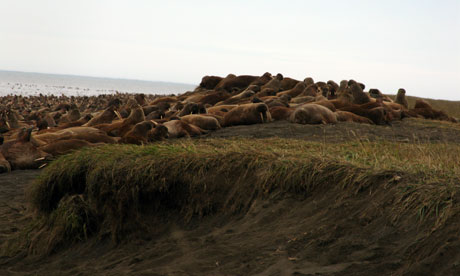
Scientists in the Arctic are reporting a rare mass migration of thousands of walrus from the ice floes to dry land along Alaska's coast.
Researchers from the US Geological Survey (USGS), who have been tracking walrus movements using satellite radio tags, say 10,000 to 20,000 of the animals, mainly mothers and calves, are now congregating in tightly packed herds on the Alaskan side of the Chukchi Sea, in the first such exodus of its kind.
"It's something that we have never seen before in this area," said Geoff York, of the WWF's global Arctic programme. "As the ice decreases, the walrus are abandoning it earlier and earlier. They are having to swim ashore, or to linger on less suitable drift ice for long periods of time."
The flight of the walrus, first reported by the Alaska Dispatch, has reinforced warnings from scientists that the lumbering animal may be headed for extinction because of climate change.
Arctic sea ice dropped to its third lowest level in recorded history this month. The USGS study noted that the entire Chukchi shelf could be completely ice-free during August, September and October by the end of the century.
Friday, September 10, 2010
Freshwater turtles face 'bleak future'

Freshwater turtles are in catastrophic decline, according to a new analysis by Conservation International (CI).
The group says more than a third of the estimated 280 species around the world are now threatened with extinction.The unsustainable collection of turtles for food and to supply a lucrative pet trade are the key drivers behind the fall in numbers.
Habitat loss as a result of river-damming for hydro-electricity is another major concern.
Thursday, September 9, 2010
Most Penguin Populations Continue to Decline, Biologists Warn

Tuesday, September 7, 2010
Madagascar’s Pierced Heart

Subscribe to:
Posts (Atom)