WISE RIVER, Mont. — The trees spanning many of the mountainsides of western Montana glow an earthy red, like a broadleaf forest at the beginning of autumn.
But these trees are not supposed to turn red. They are evergreens, falling victim to beetles that used to be controlled in part by bitterly cold winters. As the climate warms, scientists say, that control is no longer happening.
Across millions of acres, the pines of the northern and central Rockies are dying, just one among many types of forests that are showing signs of distress these days.
From the mountainous Southwest deep into Texas, wildfires raced across parched landscapes this summer, burning millions more acres. In Colorado, at least 15 percent of that state’s spectacular aspen forests have gone into decline because of a lack of water.
The devastation extends worldwide. The great euphorbia trees of southern Africa are succumbing to heat and water stress. So are the Atlas cedars of northern Algeria. Fires fed by hot, dry weather are killing enormous stretches of Siberian forest. Eucalyptus trees are succumbing on a large scale to a heat blast in Australia, and the Amazon recently suffered two “once a century” droughts just five years apart, killing many large trees.
Experts are scrambling to understand the situation, and to predict how serious it may become.
Scientists say the future habitability of the Earth might well depend on the answer. For, while a majority of the world’s people now live in cities, they depend more than ever on forests, in a way that few of them understand.
Scientists have figured out — with the precise numbers deduced only recently — that forests have been absorbing more than a quarter of the carbon dioxide that people are putting into the air by burning fossil fuels and other activities. It is an amount so large that trees are effectively absorbing the emissions from all the world’s cars and trucks.
Without that disposal service, the level of carbon dioxide in the atmosphere would be rising faster. The gas traps heat from the sun, and human emissions are causing the planet to warm.
Yet the forests have only been able to restrain the increase, not halt it. And some scientists are increasingly worried that as the warming accelerates, trees themselves could become climate-change victims on a massive scale.
“At the same time that we’re recognizing the potential great value of trees and forests in helping us deal with the excess carbon we’re generating, we’re starting to lose forests,” said Thomas W. Swetnam, an expert on forest history at the University of Arizona.
While some of the forests that died recently are expected to grow back, scientists say others are not, because of climate change.
If forests were to die on a sufficient scale, they would not only stop absorbing carbon dioxide, they might also start to burn up or decay at such a rate that they would spew huge amounts of the gas back into the air — as is already happening in some regions. That, in turn, could speed the warming of the planet, unlocking yet more carbon stored in once-cold places like the Arctic.
Scientists are not sure how likely this feedback loop is, and they are not eager to find out the hard way.
“It would be a very different world than the world we’re in,” said Christopher B. Field, an ecologist at the Carnegie Institution for Science.
It is clear that the point of no return has not been reached yet — and it may never be. Despite the troubles of recent years, forests continue to take up a large amount of carbon, with some regions, including the Eastern United States, being especially important as global carbon absorbers.
“I think we have a situation where both the ‘forces of growth’ and the ‘forces of death’ are strengthening, and have been for some time,” said Oliver L. Phillips, a prominent tropical forest researcher with the University of Leeds in England. “The latter are more eye-catching, but the former have in fact been more important so far.”
Scientists acknowledge that their attempts to use computers to project the future of forests are still crude. Some of those forecasts warn that climate change could cause potentially widespread forest death in places like the Amazon, while others show forests remaining robust carbon sponges throughout the 21st century.
“We’re not completely blind, but we’re not in good shape,” said William R. L. Anderegg, a researcher at Stanford University.
Many scientists say that ensuring the health of the world’s forests requires slowing human emissions of greenhouse gases. Most nations committed to doing so in a global environmental treaty in 1992, yet two decades of negotiations have yielded scant progress.
In the near term, experts say, more modest steps could be taken to protect forests. One promising plan calls for wealthy countries to pay those in the tropics to halt the destruction of their immense forests for agriculture and logging.
But now even that plan is at risk, for lack of money. Other strategies, like thinning overgrown forests in the American West to make them more resistant to fire and insect damage, are also going begging in straitened times. With growing economic problems and a Congress skeptical of both climate science and new spending, chances for additional funding appear remote.
So, even as potential solutions to forest problems languish, signs of trouble build.
more here
Saturday, November 5, 2011

Saturday, October 1, 2011
Ecological Debt- The alarming rate of resource depletion
The most dominant species in Earth's history, in other words, is living beyond the planet's threshold of sustainability, trashing the house it lives in.
At its current pace of consumption humankind will need, by 2030, a second globe to satisfy its voracious appetites and absorb all its waste, the report calculated.
Earth's seven billion denizens -- nine billion by mid-century -- are using more water, cutting down more forests and eating more fish than Nature can replace, it said.
At the same time, we are disgorging more CO2, pollutants and chemical fertilizers than the atmosphere, soil and oceans can soak up without severely disrupting the ecosystems that have made our planet such a comfortable place for homo sapiens to live.
Counting down from January 1, the date when human activity exceeds its budget -- dubbed "Earth Overshoot Day" -- had receded by about three days each year since 2001.
The tipping point into non-sustainability happened sometime in the 1970s, said the Oakland, California-based Global Footprint Network, which issued the report.
This year, researchers estimate that the equivalent of Earth's resource quota will be depleted on September 27.
"That's like spending your annual salary three months before the year is over, and eating into savings year after year," Global Footprint Network President Mathis Wackernagel said in a statement.
"Pretty soon, you run out of savings."
Even as Earth's capacity to host our ever-expanding species diminishes, the demands on "ecosystem services" -- the term scientists use to describe Nature's bounty -- continues to grow.
"From soaring food prices to the crippling effects of climate change, our economies are now confronting the reality of years of spending beyond our means," Wackernagel said.
UN chief Ban Ki-moon earlier this month said sustainable development now tops the global agenda of issues demanding urgent action.
"Overshoot" is driven by three factors: how much we consume, the global population, and how much Nature can produce.
Technology has vastly boosted productivity of edible plants and animals, but that expansion has barely kept pace with the rate at which demand has increased, the report said.
As critical, it has not taken into account all the collateral damage inflicted on the environment.
The United States is the biggest ecological deficit spender, according to an earlier calculation by the same group.
If all people adopted the American lifestyle -- big house, two cars, huge per-capita energy consumption -- the world's population would need about five "Earths" to meet its needs.
By contrast, if everyone on Earth matched the average footprint of someone in India today, humanity would be using less than half the planet's biocapacity.
But as India, China and other emerging giants continue to grow their economies at breakneck pace -- fuelled in large part by the desire for a "Western" lifestyle -- that per-capita footprint will become much larger, scientists warn.
Already today, for example, China is the top emitter of greenhouse gases and the top producer of automobiles.
At its current pace of consumption humankind will need, by 2030, a second globe to satisfy its voracious appetites and absorb all its waste, the report calculated.
Earth's seven billion denizens -- nine billion by mid-century -- are using more water, cutting down more forests and eating more fish than Nature can replace, it said.
At the same time, we are disgorging more CO2, pollutants and chemical fertilizers than the atmosphere, soil and oceans can soak up without severely disrupting the ecosystems that have made our planet such a comfortable place for homo sapiens to live.
Counting down from January 1, the date when human activity exceeds its budget -- dubbed "Earth Overshoot Day" -- had receded by about three days each year since 2001.
The tipping point into non-sustainability happened sometime in the 1970s, said the Oakland, California-based Global Footprint Network, which issued the report.
This year, researchers estimate that the equivalent of Earth's resource quota will be depleted on September 27.
"That's like spending your annual salary three months before the year is over, and eating into savings year after year," Global Footprint Network President Mathis Wackernagel said in a statement.
"Pretty soon, you run out of savings."
Even as Earth's capacity to host our ever-expanding species diminishes, the demands on "ecosystem services" -- the term scientists use to describe Nature's bounty -- continues to grow.
"From soaring food prices to the crippling effects of climate change, our economies are now confronting the reality of years of spending beyond our means," Wackernagel said.
UN chief Ban Ki-moon earlier this month said sustainable development now tops the global agenda of issues demanding urgent action.
"Overshoot" is driven by three factors: how much we consume, the global population, and how much Nature can produce.
Technology has vastly boosted productivity of edible plants and animals, but that expansion has barely kept pace with the rate at which demand has increased, the report said.
As critical, it has not taken into account all the collateral damage inflicted on the environment.
The United States is the biggest ecological deficit spender, according to an earlier calculation by the same group.
If all people adopted the American lifestyle -- big house, two cars, huge per-capita energy consumption -- the world's population would need about five "Earths" to meet its needs.
By contrast, if everyone on Earth matched the average footprint of someone in India today, humanity would be using less than half the planet's biocapacity.
But as India, China and other emerging giants continue to grow their economies at breakneck pace -- fuelled in large part by the desire for a "Western" lifestyle -- that per-capita footprint will become much larger, scientists warn.
Already today, for example, China is the top emitter of greenhouse gases and the top producer of automobiles.
The New Normal : The world’s climate has already changed. Now what?
Right now, New Mexico is warmer than it was a decade ago. Since the 1960s, the growing season has lengthened. More than half of the state’s native plants and animals have already been affected by climate change; some bird populations have shifted; some flowers bloom earlier. Sand dunes are spreading as vegetation dies. Conifer forests, weakened by drought and susceptible to bark beetles (whose numbers soared thanks to warmer temperatures) are suffering die-offs. Day to day, we have low river flows, dry soils and wildfires. Already this fiscal year, 1,242 square miles of New Mexico have burned. Worldwide, scientists are watching their models and predictions play out—and we’re all experiencing symptoms no one expected.
McCarthy is The Nature Conservancy’s director of conservation programs and also director of the Conservancy’s Southwest Climate Change Initiative. He has authored a number of reports detailing changes already occurring, predictions and adaptive management. He also works on what used to be called “ecological management” and is now known as “transformation ecology.” As one of the first places hit by human-caused climate change in New Mexico, the Jemez Mountains have become a laboratory. (The only place in the state that has warmed more in recent years is southwestern New Mexico’s boot heel.) “We’re moving beyond denial to acceptance that we can’t restore these forests anymore—because the forest of 50, 100 years ago wouldn’t survive in 2050,” McCarthy says. “So the question becomes: What is an ecosystem that’s sustainable in 20 or 50 years?”
McCarthy is The Nature Conservancy’s director of conservation programs and also director of the Conservancy’s Southwest Climate Change Initiative. He has authored a number of reports detailing changes already occurring, predictions and adaptive management. He also works on what used to be called “ecological management” and is now known as “transformation ecology.” As one of the first places hit by human-caused climate change in New Mexico, the Jemez Mountains have become a laboratory. (The only place in the state that has warmed more in recent years is southwestern New Mexico’s boot heel.) “We’re moving beyond denial to acceptance that we can’t restore these forests anymore—because the forest of 50, 100 years ago wouldn’t survive in 2050,” McCarthy says. “So the question becomes: What is an ecosystem that’s sustainable in 20 or 50 years?”
Thursday, September 29, 2011
Climate Change Causing Massive Changes In European Fisheries
There may be nothing new under the sun, but beneath the sea is a different story. Scientists studying 28 years of data from the Atlantic Ocean have found that climate change is causing drastic changes in fish populations off the European coast--and that's bad news for cold-loving species like cod, which have fed generations of Northern Europeans.
The North Sea, a cold wind-swept patch of the Atlantic stretching from Scandinavia to the U.K., is warming four times faster than the global average. During the last 30 years, the roughly 2°F increase in mean annual temperature (the North Sea swings between 63°F and 43°F during the summer and winter) has had a profound influence on fish growth and survival, egg maturation, and the plankton supporting food webs and commercial fisheries.
British scientists analyzed 11 surveys, covering at least a million square kilometers of the European continental shelf, and more than 100 million fish, "to get the 'big picture' of how warming is affecting fish communities," according to Stephen Simpson of the University of Bristol, whose research appears in a recent issue of Current Biology. They found that 72% of common fish species had responded to rising sea temperatures. Most species--three out of four--were growing more abundant, and hake and dab had doubled, while catches of cold-loving species, including haddock and cod, dropped by half.
"We see many more southerly, warm-water species faring well on the European shelf than more northerly, cold-adapted species," said Simpson in a statement. "This means more small-bodied, faster-growing species with shorter generation times, and potentially more diversity." In other words, cod may be replaced by new species adapted to the warmth such as red mullet and John dory.
The findings, while new, were not wholly unexpected. Previous research predicted massive shifts in the world's fisheries as the oceans warmed slowly under the influence of climate change. And in 2009, Princeton University and British researchers estimated that fish distribution was likely to shift at least 40 km each decade as southern species overtook ranges of cold-water species. While Nordic countries such as Norway might see catches rise, developing countries in the tropics would suffer the most and some polar species could face extinction. Fish and chips, get ready to meet your maker.
Sunday, September 25, 2011
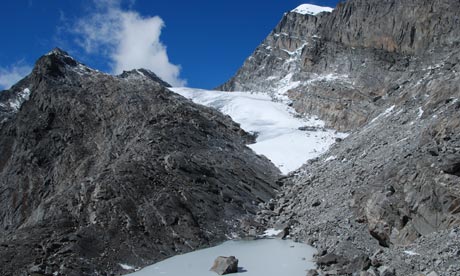
Everest's ice is retreating as climate change grips the Himalaya
Climate change is altering the face of the Himalayas but research seeking to confirm this is yet to catch up with the mountain communities sounding the alarm. After an 18-day trek with scientists, Suzanne Goldenberg finds the warning signs hard to ignore

The climb to Everest base camp is a journey into a monochrome world, a landscape reduced to rock, ice and grey sky. The only spots of colour are the bright, domed tents of the few climbing teams willing to attempt the summit in the off-season.
There are no birds, no trees, just the occasional chunks of glacier splashing into pools of pale green meltwater like ice cubes in some giant exotic drink. The stillness suggests nothing has changed for decades, but Tshering Tenzing Sherpa, who has been in charge of rubbish collection at base camp for the past few years, remains uneasy. "Everything is changing with the glaciers. All these crevasses have appeared in the ice. Before, base camp was flat, and it was easy to walk," he said.
Climbers had reported that they barely needed crampons for the climb, there was so much bare rock, Tenzing said. That's not how it was in Edmund Hillary's day. Tenzing pointed towards the Khumbu ice fall – the start of the climb, and part of a 16km stretch of ice that forms the largest glacier in Nepal. "Before, when you looked out, it was totally blue ice, and now it is black rock on top," he said. He's convinced the changes have occurred in months – not years, or even decades, but during the brief interval of the summer monsoon. "This year it's totally changed," he said.
This much is known: climate change exists, it is man-made, and it is causing many glaciers to melt across the Himalayas. Beyond that, however, much is unclear or downright confusing.
The climb to Everest base camp is a journey into a monochrome world, a landscape reduced to rock, ice and grey sky. The only spots of colour are the bright, domed tents of the few climbing teams willing to attempt the summit in the off-season.
There are no birds, no trees, just the occasional chunks of glacier splashing into pools of pale green meltwater like ice cubes in some giant exotic drink. The stillness suggests nothing has changed for decades, but Tshering Tenzing Sherpa, who has been in charge of rubbish collection at base camp for the past few years, remains uneasy. "Everything is changing with the glaciers. All these crevasses have appeared in the ice. Before, base camp was flat, and it was easy to walk," he said.
Climbers had reported that they barely needed crampons for the climb, there was so much bare rock, Tenzing said. That's not how it was in Edmund Hillary's day. Tenzing pointed towards the Khumbu ice fall – the start of the climb, and part of a 16km stretch of ice that forms the largest glacier in Nepal. "Before, when you looked out, it was totally blue ice, and now it is black rock on top," he said. He's convinced the changes have occurred in months – not years, or even decades, but during the brief interval of the summer monsoon. "This year it's totally changed," he said.
This much is known: climate change exists, it is man-made, and it is causing many glaciers to melt across the Himalayas. Beyond that, however, much is unclear or downright confusing.
Sunday, September 18, 2011
Rampant consumerism must be checked, Speth says
James Gustave Speth called for people to re-devote themselves to improving the "art of living."
Flu season may be just around the corner, but environmental activist James Gustave Speth says we have a new scourge to watch for: “afluenza,” a virulent strain of consumerism that, if left unchecked, may prove fatal to our planet.
 Delivering his 2008 Beatty Memorial Lecture to a full house at the
Centre Mount Royal Auditorium on Oct. 18, the Dean of the School of
Forestry and Environmental Studies at Yale University said rampant
capitalism is the chief culprit behind the degradation of the
environment to the point where the planet’s ability to sustain life has
been seriously undermined.
Delivering his 2008 Beatty Memorial Lecture to a full house at the
Centre Mount Royal Auditorium on Oct. 18, the Dean of the School of
Forestry and Environmental Studies at Yale University said rampant
capitalism is the chief culprit behind the degradation of the
environment to the point where the planet’s ability to sustain life has
been seriously undermined.But the wheels of capitalism don’t churn by themselves. Speth listed a variety of accomplices to this ongoing environmental crime: Powerful corporate entities whose overriding objective is to grow profits regardless of the effect on the natural world; continual investment in technologies originally designed with little or no thought to the environment; markets that systematically fail to recognize environmental costs unless they are legislated to do so by government; governments that are subservient to corporate entities; and run-away consumerism spurred by sophisticated advertising and marketing – all have had a hand in ramping up capitalism and consumption to frenzied, and dangerous, levels.
“It took all of history to grow the $7-trillion world economy that we had when I was a little boy in 1950,” he said. “But how long does it take to add another $7-trillion to world economic activity today? Less than a decade.
“We have created a huge economic machine that is profoundly committed to profits and growth and almost totally indifferent to nature and society,” he continued. “Left unchecked it is both ruthless and rapacious.”
But, according to Speth, to cage the ruthless beast will require nothing short of a revolution. First, he said, people must challenge the “growth fetish.” The heedless accumulation of goods and property must be tempered by newly conceived markets in which prices are driven upward to reflect the true environmental impact of products. “Polluters must pay,” Speth said.
Second, we must move toward a kinder, gentler “post-growth life” of improved health care for everyone, better education, shorter work weeks and longer vacations. Citing philosopher John Stuart Mill, Speth said we must go back to the future and re-devote ourselves to “improve the art of living.”
“Materialism is toxic to happiness,” he said. “We must look forward to the day we can get off the treadmill of this hyperventilating lifestyle.”
While Speth was quick to admit he doesn’t have the answers to the question how do we get from here to there, he did suggest it would probably take a series of events to serve as a catalyst for change. We will need a powerful grassroots movement or a proliferation of mold-breaking movements that would galvanize people. We will need a crisis or the semblance of an imminent crisis, and we will need leaders who aren’t afraid to talk about sacrifice and giving up luxuries, leaders who are able to “articulate a new story.” When asked if such a leader exists, Speth tipped his electoral hand and said: “Wait ’til November.”
“Our best hope for real change is a fusion of those concerned about the environment, of those concerned about justice and fairness, and those concerned about building strong political democracy,” he said. “The fusion of these things will create one powerful, progressive force. We’ve got to remember that we are all in a community of shared faith. We are all in the same boat and we will rise or fall together.”
At the end of his lecture Speth spoke directly to the students in the audience to step forward and take action.
“This is your world. Get active before it is too late. If there is a period to look for guidance, it is the 1960s and the Civil Rights movement. People struggled, people took risks and after 40 years I think it is time we followed in the footsteps of Dr. King.
“There is too much at stake to sit on the sidelines.”
Thursday, September 8, 2011
Going Green but Getting Nowhere
YOU reduce, reuse and recycle. You turn down plastic and paper. You
avoid out-of-season grapes. You do all the right things.
Good.
Just know that it won’t save the tuna, protect the rain forest or stop global warming. The changes necessary are so large and profound that they are beyond the reach of individual action.
You refuse the plastic bag at the register, believing this one gesture somehow makes a difference, and then carry your takeout meal back to your car for a carbon-emitting trip home.
Say you’re willing to make real sacrifices. Sell your car. Forsake your air-conditioner in the summer, turn down the heat in the winter. Try to become no-impact man. You would, in fact, have no impact on the planet. Americans would continue to emit an average of 20 tons of carbon dioxide a year; Europeans, about 10 tons.
What about going bigger? You are the pope with a billion followers, and let’s say all of them take your advice to heart. If all Catholics decreased their emissions to zero overnight, the planet would surely notice, but pollution would still be rising. Of course, a billion people, whether they’re Catholic or adherents of any other religion or creed, will do no such thing. Two weeks of silence in a Buddhist yoga retreat in the Himalayas with your BlackBerry checked at the door? Sure. An entire life voluntarily lived off the grid? No thanks.
And that focuses only on those who can decrease their emissions. When your average is 20 tons per year, going down to 18 tons is as easy as taking a staycation. But if you are among the four billion on the planet who each emit one ton a year, you have nowhere to go but up.
Leading scientific groups and most climate scientists say we need to decrease global annual greenhouse gas emissions by at least half of current levels by 2050 and much further by the end of the century. And that will still mean rising temperatures and sea levels for generations.
So why bother recycling or riding your bike to the store? Because we all want to do something, anything. Call it “action bias.” But, sadly, individual action does not work. It distracts us from the need for collective action, and it doesn’t add up to enough. Self-interest, not self-sacrifice, is what induces noticeable change. Only the right economic policies will enable us as individuals to be guided by self-interest and still do the right thing for the planet.
Every ton of carbon dioxide pollution causes around $20 of damage to economies, ecosystems and human health. That sum times 20 implies $400 worth of damage per American per year. That’s not damage you’re going to do in the distant future; that’s damage each of us is doing right now. Who pays for it?
We pay as a society. My cross-country flight adds fractions of a penny to everyone else’s cost. That knowledge leads some of us to voluntarily chip in a few bucks to “offset” our emissions. But none of these payments motivate anyone to fly less. It doesn’t lead airlines to switch to more fuel-efficient planes or routes. If anything, airlines by now use voluntary offsets as a marketing ploy to make green-conscious passengers feel better. The result is planetary socialism at its worst: we all pay the price because individuals don’t.
It won’t change until a regulatory system compels us to pay our fair share to limit pollution accordingly. Limit, of course, is code for “cap and trade,” the system that helped phase out lead in gasoline in the 1980s, slashed acid rain pollution in the 1990s and is now bringing entire fisheries back from the brink. “Cap and trade” for carbon is beginning to decrease carbon pollution in Europe, and similar models are slated to do the same from California to China.
Alas, this approach has been declared dead in Washington, ironically by self-styled free-marketers. Another solution, a carbon tax, is also off the table because, well, it’s a tax.
Never mind that markets are truly free only when everyone pays the full price for his or her actions. Anything else is socialism. The reality is that we cannot overcome the global threats posed by greenhouse gases without speaking the ultimate inconvenient truth: getting people excited about making individual environmental sacrifices is doomed to fail.
High school science tells us that global warming is real. And economics teaches us that humanity must have the right incentives if it is to stop this terrible trend.
Don’t stop recycling. Don’t stop buying local. But add mastering some basic economics to your to-do list. Our future will be largely determined by our ability to admit the need to end planetary socialism. That’s the most fundamental of economics lessons and one any serious environmentalist ought to heed.
Good.
Just know that it won’t save the tuna, protect the rain forest or stop global warming. The changes necessary are so large and profound that they are beyond the reach of individual action.
You refuse the plastic bag at the register, believing this one gesture somehow makes a difference, and then carry your takeout meal back to your car for a carbon-emitting trip home.
Say you’re willing to make real sacrifices. Sell your car. Forsake your air-conditioner in the summer, turn down the heat in the winter. Try to become no-impact man. You would, in fact, have no impact on the planet. Americans would continue to emit an average of 20 tons of carbon dioxide a year; Europeans, about 10 tons.
What about going bigger? You are the pope with a billion followers, and let’s say all of them take your advice to heart. If all Catholics decreased their emissions to zero overnight, the planet would surely notice, but pollution would still be rising. Of course, a billion people, whether they’re Catholic or adherents of any other religion or creed, will do no such thing. Two weeks of silence in a Buddhist yoga retreat in the Himalayas with your BlackBerry checked at the door? Sure. An entire life voluntarily lived off the grid? No thanks.
And that focuses only on those who can decrease their emissions. When your average is 20 tons per year, going down to 18 tons is as easy as taking a staycation. But if you are among the four billion on the planet who each emit one ton a year, you have nowhere to go but up.
Leading scientific groups and most climate scientists say we need to decrease global annual greenhouse gas emissions by at least half of current levels by 2050 and much further by the end of the century. And that will still mean rising temperatures and sea levels for generations.
So why bother recycling or riding your bike to the store? Because we all want to do something, anything. Call it “action bias.” But, sadly, individual action does not work. It distracts us from the need for collective action, and it doesn’t add up to enough. Self-interest, not self-sacrifice, is what induces noticeable change. Only the right economic policies will enable us as individuals to be guided by self-interest and still do the right thing for the planet.
Every ton of carbon dioxide pollution causes around $20 of damage to economies, ecosystems and human health. That sum times 20 implies $400 worth of damage per American per year. That’s not damage you’re going to do in the distant future; that’s damage each of us is doing right now. Who pays for it?
We pay as a society. My cross-country flight adds fractions of a penny to everyone else’s cost. That knowledge leads some of us to voluntarily chip in a few bucks to “offset” our emissions. But none of these payments motivate anyone to fly less. It doesn’t lead airlines to switch to more fuel-efficient planes or routes. If anything, airlines by now use voluntary offsets as a marketing ploy to make green-conscious passengers feel better. The result is planetary socialism at its worst: we all pay the price because individuals don’t.
It won’t change until a regulatory system compels us to pay our fair share to limit pollution accordingly. Limit, of course, is code for “cap and trade,” the system that helped phase out lead in gasoline in the 1980s, slashed acid rain pollution in the 1990s and is now bringing entire fisheries back from the brink. “Cap and trade” for carbon is beginning to decrease carbon pollution in Europe, and similar models are slated to do the same from California to China.
Alas, this approach has been declared dead in Washington, ironically by self-styled free-marketers. Another solution, a carbon tax, is also off the table because, well, it’s a tax.
Never mind that markets are truly free only when everyone pays the full price for his or her actions. Anything else is socialism. The reality is that we cannot overcome the global threats posed by greenhouse gases without speaking the ultimate inconvenient truth: getting people excited about making individual environmental sacrifices is doomed to fail.
High school science tells us that global warming is real. And economics teaches us that humanity must have the right incentives if it is to stop this terrible trend.
Don’t stop recycling. Don’t stop buying local. But add mastering some basic economics to your to-do list. Our future will be largely determined by our ability to admit the need to end planetary socialism. That’s the most fundamental of economics lessons and one any serious environmentalist ought to heed.
Subscribe to:
Posts (Atom)